Since its inception in the 1980s, private equity and private equity-sponsored firms have come to dominate the private credit market. Most private credit funds are created by nominally private equity firms, such as KKR, or alternate asset managers, such as Blackstone, but private credit has become increasingly independent with more private credit exclusive firms being started. Indeed, private credit is now the second largest private markets strategy, overtaking venture capital. However, the once inseparable relationship between the two halves may be changing. The previously dominant private equity firm may now take a back seat in the news and economic cycle to private credit firm’s moment in the limelight. In this article, GreySpark discusses the evolving interconnection of the two halves of private markets and how they may be moving away from one another.
By GreySpark’s Declan Sharp, Analyst Consultant, and Rachel Lindstrom, Head of Capital Markets Intelligence


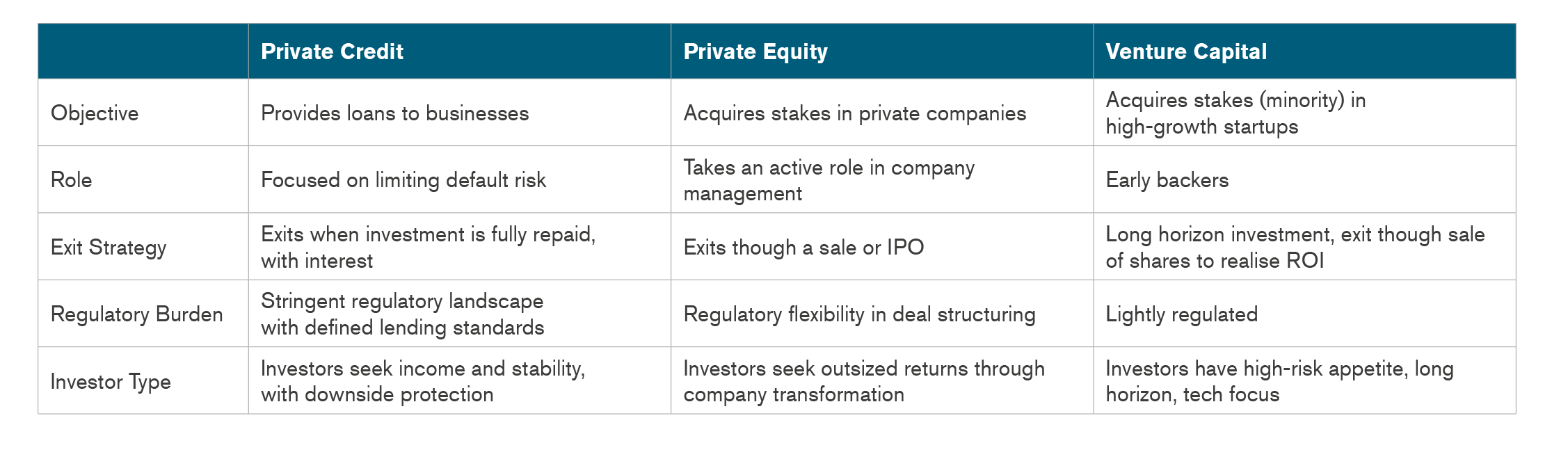
Private markets have grown rapidly in recent years, with private equity and private credit emerging as two of the most significant asset classes driving this expansion. While they are closely connected (often financing the same companies) they serve different roles within the capital structure and appeal to investors with different objectives. Figure 1 provides the basic characteristics of these two types of investment and how it compares to venture capital.
Figure 1: Comparing the Characteristics of Private Credit, Private Equity and Venture Capital Investment
Source: GreySpark analysis
(Click image to enlarge)

The Complex Relationship Between Private Credit Funds and Private Equity Funds
Private credit funds outperformed private equity funds last year according to research shown in Figure 2. Historically, the growth of private credit has been intertwined with that of private equity, as private credit funds were often initially spun out of private equity firms and are based on a business model of funding private equity investments. Indeed, 81.2% of private credit funds’ assets under management (AUM) are in firms that also have private equity funds and, in terms of count, 42.3% of private credit funds also exist in firms with private equity funds.
This suggests that private credit AUM is weighted toward large private markets players with funds in either private market hemisphere. The International Monetary Fund (IMF) says that, in the US, 72% of private credit funded deals come from firms that are private equity-sponsored, compared with 77% in Europe. On the other hand, the Bank of International Settlements (BIS) estimates the number is as high as 78% in the US. The two halves are clearly co-dependent but current macro trends have some regulators and academics suggesting that the relationship in its current form could turn toxic. Indeed, the growth of private credit is now risking the previous dynamics. Private Credit funds are showing greater yield, as shown in Figure 2. High interest rates are not just creating high yields for private credit investors, but they are making private credit loans less affordable for private equity-backed companies.
A private credit fund is an investment vehicle that pools money from institutional and accredited investors to make loans or provide debt financing to companies outside of traditional banks and public bond markets.

There May be Trouble Ahead
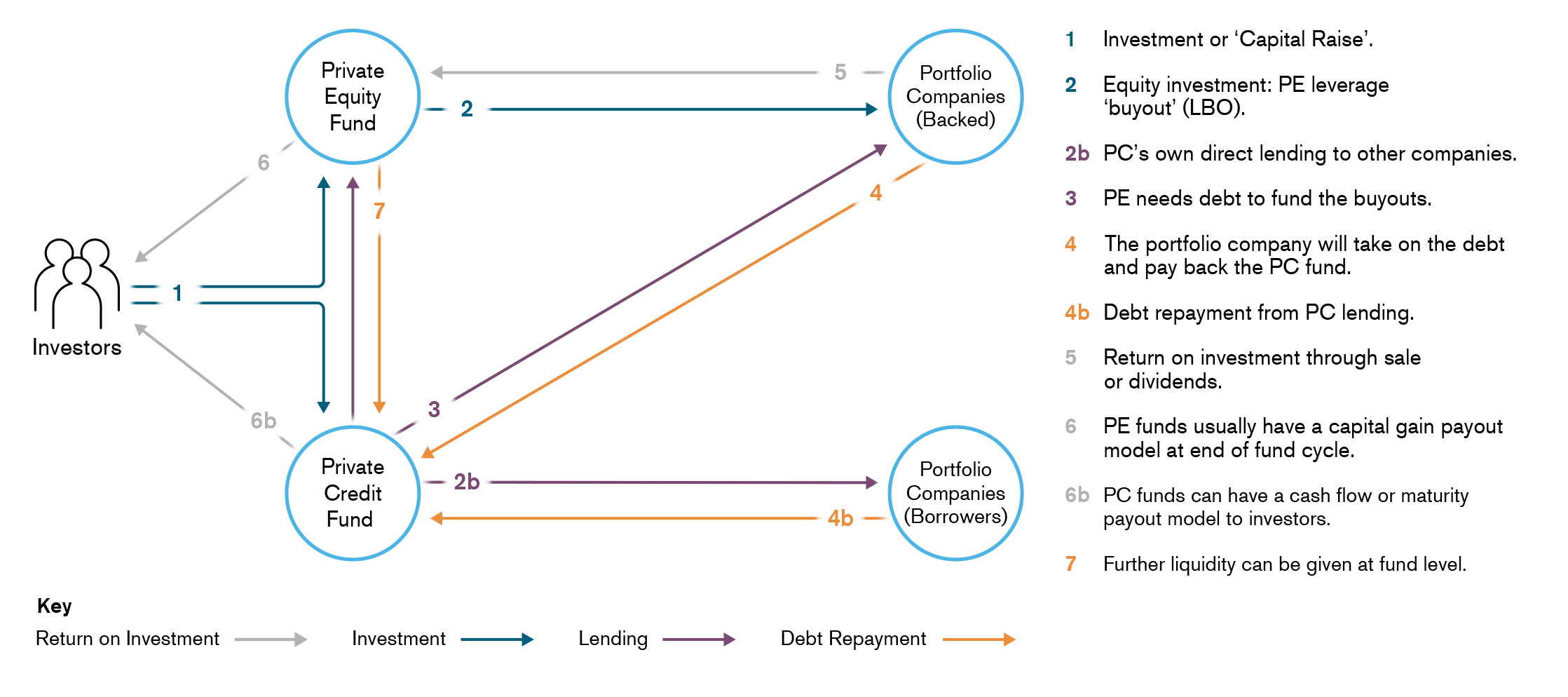
Many private equity firms expanded their private credit operations, and ‘influenced’ portfolio companies to borrow from credit funds, effectively building out in-house lending capabilities to fill the gap left by retreating banks. Thus, the private credit model was dependent on the private equity firms creating funds and needing non-bank lending. Banks are less eager to take loans from the riskier middle market lenders, which may also struggle to raise capital through the public bond markets. This unmet demand is allowing private credit to swoop in to serve SMEs, unrated firms and mid-market companies. Therefore, firms with worse, or potentially negative earnings (EBITDA) and lower tangible collateral value, are ‘underserved by banks’ and are taking up the opportunity to negotiate bespoke and flexible loans with funds instead. The data shows that private credit funds grew at an average of 20% per year in the US, and 17% per year in Europe, between 2018 and 2023. Private Credit also offers flexible funding options for leveraged buyouts as well. Private equity’s leverage buyout model is dependent on debt funding from these private credit funds, or banks, needing to leverage increasing potential returns for equity investors. Private Credit is increasingly funding LBOs over banks, but banks still command a sizeable share of financing. The leverage buyout model for private equity firms with private credit debt funding is shown in Figure 3.
Private equity and private credit backing are changing the ways businesses can run from when they were bank-backed. Whether private equity-sponsorship aids the credit quality of private loans is disputed and raises the question of whether the relationship was ever as good as it appeared on the outside. Private equity sponsors, in theory, may actually benefit the overall governance of many firms because they typically want to preserve the long-term value of the investment and may have the funds or ability to attain further funds, if needed. Indeed, in the leveraged-loan market at least, private equity-backed firms have lower default rates during periods of stress. There is some support for the notion that private credit can improve a firm’s governance due to the increased input in firm governance that funds have. Direct lenders are able to negotiate covenants on their loans with borrowers directly and are able to renegotiate and refinance loans in ways that traditional bank lending may be unable to do.
Private credit funds have exhibited a similar ability to enforce governance over borrower firms to private equity investors because of the significant about of covenants they are able to demand in their loan agreements. This has created a new adjustable debt relationship and an equity-like governance relationship in regard to how covenants enforce the governance of the business. Furthermore, private equity sponsors may help align the governance of a firm with the interests of debt holders by imposing strict targets. Private credit is more likely to fund weaker firms with low or negative earnings and higher leverage, to which banks may not lend. Private credit’s flexibility and its demands, most likely in the form of covenants will thus impact corporate finance at any point in a firm’s relationship with private credit and equity sponsors and will significantly impact bankruptcy proceedings, if it comes to that, for any borrowing firm.
Portfolio companies are the businesses that a private equity, venture capital or private credit fund have invested in.
Direct lending is the most common type of private credit loan and usually refers to a bespoke first lien loan from a singular lender (fund) to a mid-market company. Often this is a private equity-backed company.
Figure 3: The Leverage Buyout Model Using PC Fund Financing
Source: GreySpark analysis
(Click image to enlarge)
I am text block. Click edit button to change this text. Lorem ipsum dolor sit amet, consectetur adipiscing elit. Ut elit tellus, luctus nec ullamcorper mattis, pulvinar dapibus leo.
Too Much Dry Powder Below Deck
Currently, the private equity dry powder is estimated to be around USD 2 tr and private credit dry powder at around USD 600 bn. This suggests that both sides of the partnership are unable to find suitable companies to fund. A huge portion of private equity debt financing is still provided by banks, however, so private credit does not fully dominate this industry, and has room to grow by taking away further business from banks. Some argue that given bank lending still makes up a significant portion of lending to private equity, the private credit market is still too small to finance its other half and can further take business away from banks. However, this argument is potentially misplaced. If both private credit and private equity funds have such significant dry powder, and private credit typically lends to riskier borrowers than banks, then either private equity funds cannot find suitable companies to buyout or banks are turning them down. The former point is supported by the finding that an estimated 24% of private equity capital has been on fund books for at least four years without being called for investment in new portfolio companies. The fact that private equity exits are worsening – private equity capital raises over the past two years have been poor – suggests that the market is slowing. Companies, including private equity-backed ones, are turning to private credit for liquidity, and turning to traditional lenders only when they require more runway.
Dry powder is unspent, committed capital that investors (LPs) have pledged to a fund but that has not yet been deployed into deals.
The New Normal for Private Credit
The symbiosis between private credit and private equity is, therefore, changing. Investors are increasingly trying to cash out of private equity funds when returns have dwindled, and the funds are creating continuation vehicles (CVs) in the hope of getting possible returns further down the line. Therefore, as private equity exits have slowed, NAV-based lending has exploded, raising questions about asset quality and systemic resilience within private credit. Private equity giants are further moving to expand their private credit offerings. Private equity’s buyout model is currently running into trouble, according to the FT, and the market is slowing in both fundraising and dealmaking. This may mean that a rise in private equity-backed firms, and the fact that private equity funds themselves need further credit from private credit funds could be a bad sign for private markets.
CVs, which are simply new legal entities that continue fund interests in some portfolio companies of a fund after the fund life cycle was initially supposed to finish are on the rise. This suggest private equity exits from firms are not reaching the capital gains required for investors and funds. These vehicles need liquidity to help fund the process required when the returns of the companies themselves are not sufficient. Furthermore, the extent to which private equity firms are establishing CVs from their own funds or buying interests from other funds, suggests a market that is struggling to find suitable exits as the last four years have all been below cash return expectations from fund exits across the industry. Therefore, a rise in CVs may be a great business opportunity for private credit but not actually a great sign for private markets on the whole.
Current macro trends in terms of high rates and a worsening economy will potentially cause a rift between private credit and private equity. In a higher rate environment this increases potential misalignment between sponsors and debt holders. Rising inflation, tariff and other economic distress signals could provide negative pressure on the entire private credit operating model, especially its relationship with private equity. Countering the assertion by the IMF that private equity-sponsoring puts downward pressure on defaults, Private Debt Investor asserted last year that the top 12 private equity firms backed companies that had default rates of 14.3% between 2022 and August 2024, only slightly lower than the 16.7% of other private equity-backed companies. The default rate on the other hand for non-private equity-backed companies was only 7.1% over the same period. Fitch said that the default rate for their pool of private credit fund loans actually went up to 5.7% in Q2 2025. This trend could be macro though, as Moody’s recently released a special report on default risk, asserting that 9.2% of US firms are at risk of default, the highest proportion since the global financial crisis in 2008. Private credit losses were higher leverage loans and bank loans in a ten year period from 2013 to 2022. Moreover, unlike private equity funds, only 40% of private credit funds have ‘skin in the game’ creating the “scope for incentive misalignment between debt and equity holders in PE sponsored businesses thus bring PC funds and PE funds at long heads in terms of future governance of sponsored businesses”.
Continuation vehicles (CV) are legal structures that allow private equity firms to hold onto portfolio companies that are not yet ready for exit.
Net-asset-value (NAV) borrowing, which provides credit based on the underlying value of fund assets. NAV vehicles are often used to accelerate LP distribution, exits or to help fund continuation vehicles.
Private Credit is Expanding its Horizons
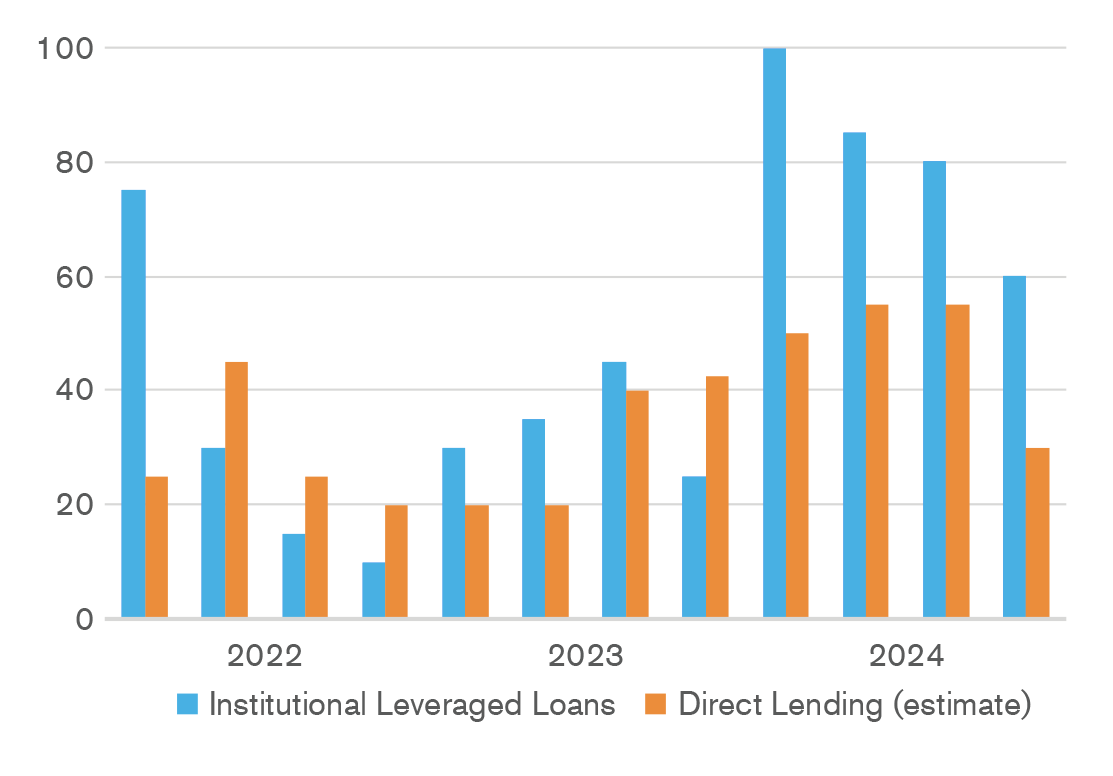
Private credit loans have typically higher rates than other types of lending because they have a risk and adaptability premium incorporated. As private equity fund yields continue to stagnate and rates remain relatively high, albeit they are now trending downward, this misalignment of interests between private credit and private equity may grow. The higher rate spread of private credit lending is most likely even less palatable now in a higher rate environment and private equity may seek to borrow more from banks. This is supported by Pitchbook data that shows that there was greater new-issue loan volume for private equity-backed borrowers from banks – in the form of ‘institutional leveraged loans’ – than from direct lenders (private credit funds) between Q1 2023 to Q4 2024, but for one quarter. This aligns with the significant rate rises that happened in 2022, and then Q1 2023, as shown in Figure 4. It is, therefore, wise for private credit to grow into other strategies, and move its focus away from solely lending to private equity and private equity-backed sponsored companies. Some private credit funds have even announced their shift away from sponsored businesses. In a lowering rate environment, these trends could be reversed but there is further evidence that private equity is seeking BSL funding in the low rate environment and covenant-lite loans, as opposed to covenant heavy private credit loans. Indeed, private credit has consolidated its foothold on the smaller buyouts in the under USD 1 bn category with almost no deals in this space being recently funded through BSLs, but it is losing ground in larger deals.
Continuation vehicles (CV) are legal structures that allow private equity firms to hold onto portfolio companies that are not yet ready for exit.
Net-asset-value (NAV) borrowing, which provides credit based on the underlying value of fund assets. NAV vehicles are often used to accelerate LP distribution, exits or to help fund continuation vehicles.
Private credit does have to see new industries in a high-rate environment as private credit loans become less attractive and private credit backers keep wanting the high yields private credit has offered. Large private market giants are conducting significant capital raises (asking for investors for capital) for private credit funds that focus on consumer finance and real estate. Banks have reportedly increasingly sought to reduce their exposure to high risk commercial real estate such that private credit can now step in. Additional collateral will be sought as the creditworthiness of US borrowers is decreasing according to Moody’s. KKR has recently released a ‘primer’ on asset-backed finance (ABF), which is an indication that they see the space as a key growth channel for alternative investments for their clients. It was recently reported that the firm has completed a USD 6.5 bn capital raise for ABF funds. Private credit financing offers unique opportunities to finance or securitise funding of industries that have recently struggled to get bank credit. Private credit is, therefore, financing ‘the real economy’, as Blackstone puts it, which includes infrastructure, real estate and the onshoring of industrial manufacturing. It happens that project timelines and potential profitability lend themselves to adjustable loans vehicles that characterise private credit. Large data centre and processor investment is becoming a new sub-sector, requiring significant debt capital investment, as shown by the already USD 24 bn in deals2 in the US. That Meta is seeking USD 26 bn of debt for a data centre joint venture shows the tech giant support for these sorts of partnerships.
Private credit has expanded its scope by developing its high-yield business of consumer finance and buy-now-pay-later (BNPL) financing. It is doing this either by providing credit facilities to the consumer finance firms or buying consumer debt itself. The hedge fund, Elliot, reportedly bought debt from consumer finance provider, Klarna, in 2024. This was part of a wider trend of hedge funds entering the private credit market. Buy-Now-Pay-Later (BNPL) has traditionally been funded by banks, but that is changing with private credit and private equity stepping in.
Institutional leveraged loans are rated BB+ or lower or are BBB- or higher but have both a spread over 125 bpds and are secured by the first or second lien.
Figure 4: Private Equity-backed LBO Debt Issuance Over the Past Two Years (USD billions)
Source: Pitchbook
(Click image to enlarge)
Funding the ‘Real Economy’
Many firms and commentators predict that private credit will grow in Europe. European private credit AUM grew from EUR 150 bn to EUR 430 bn from 2014 to 2024, whereas private equity grew from EUR 440 bn to EUR 1.2 tr over the same period. Investors seemingly see things similarly as ‘Europe-focused‘ private credit fundraising for the year to March 2020 totalled USD 25.71 bn, almost triple the USD 9.27 bn raised by US-focused counterparts in the same time period.
At the other end of the market, private credit may be encroaching into the burgeoning asset-class of venture debt. Venture debt offers early stage startups a further runway without dilution of their equity and is often seen as a preferable funding option, not simply for the capital structure of the company, but also as it allows the existing directors continued control of the company. If the venture debt market is growing substantially in the US, this may suggest a strong cooling of scale-up firm preference for further equity funding in exchange for debt. Startups need Angel and venture capital equity investment during a period of limited cashflow but scale-ups with revenue may be able to get debt funding from private credit funds or maybe even banks. However, given private credit loans have higher interest rates than banks and are often more covenant heavy, they are more costly and onerous on the borrower, therefore. If scale-ups are preferring venture debt, it means they are preferring these very onerous loan terms, which potentially suggests that SMEs are getting tired of the venture capital ecosystem.
According to Pitchbook, venture debt had a record year in 2024 (in the US and EU), but is now pacing below that in 2025. To scaleup firms (those startups entering the next stage of their growth journey), venture debt has become a welcome option when their growth is no longer meeting venture capital expectations. Similar to the big players such as Meta above, AI start-ups and scale-ups are using their AI data centres as collateral on venture debt loans, creating ‘silicon-backed loans’. With tariffs impacting startups and SMEs, these companies are turning to venture debt to provide liquidity in volatility. In the US, most debt funding is occurring at early stage investment, such as series A and B rounds, and venture growth rounds are happening much later when the company is more mature. Venture debt has not just risen over the recent credit cycle of higher rates, but has increased at an average annual growth rate of 17% over the past 10 years – potentially 21% CAGR in Europe’s venture debt space since 2018. This is also another way to further provide the company a runway without launching an IPO. Indeed, the growth in venture debt align with an increasing cost of equity, which may have pushed startups to choose debt over equity injection because it can lead to greater enterprise value creation, less dilution and ultimately better outcomes for management, employees and investors.
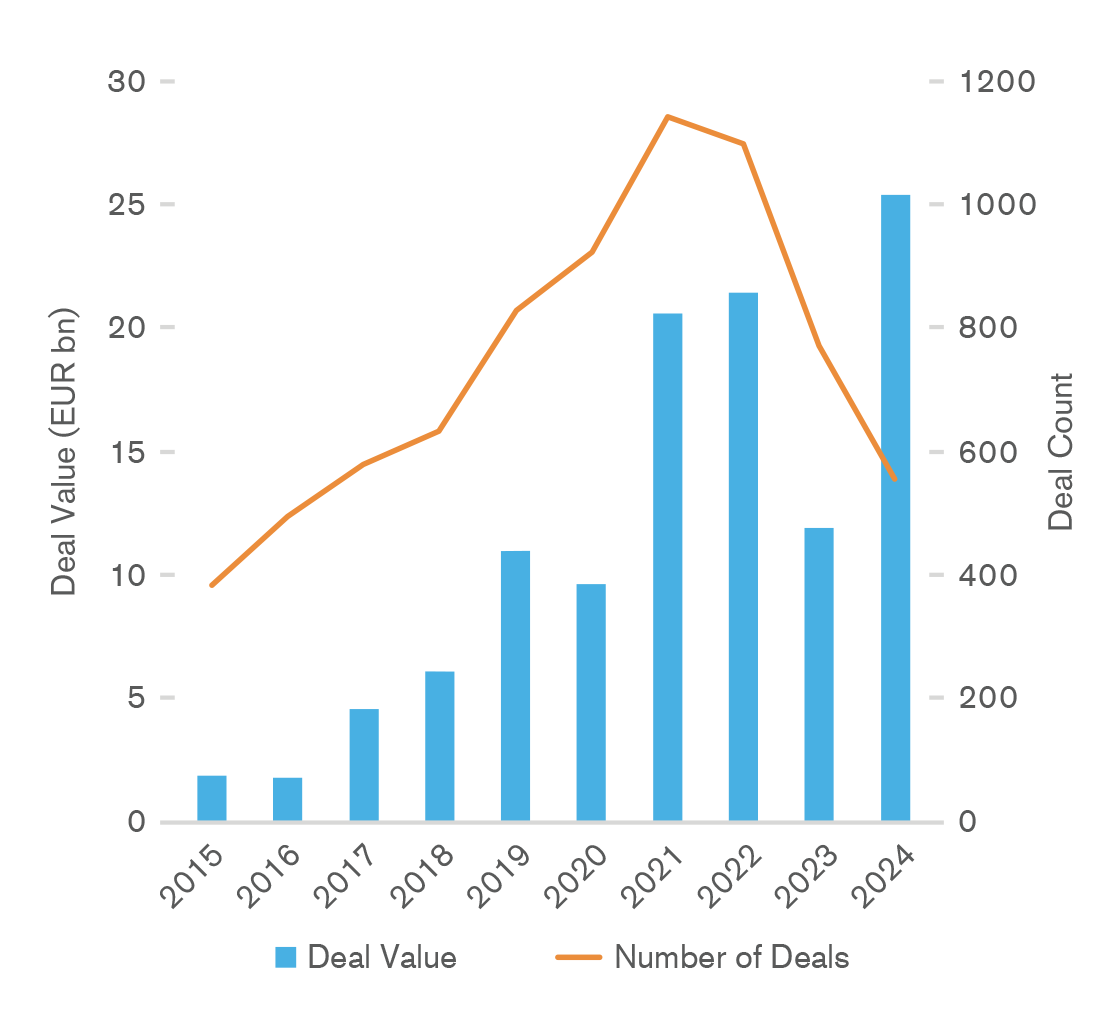
European venture debt reached EUR 61 bn, highlighting that it was also due to scaleups opting for debt instead of equity investment as shown in Figure 5. The growth of this sub-sector is significant, with the EUR deal value increasing over twelvefold in nominal terms in 9 years from 2015 to 2024.
Private Credit in Transition: Risk, Opportunity, and Diversification
Private credit is on everyone’s lips, in 2025. How it transforms itself will shape the future of debt financing. Higher rates mean it may need to decouple, from private equity to some extent. However, it could result in higher default risk. The changing credit environment will require, and allow for, private credit to move into new sectors, such as asset-based financing, consumer finance, real estate and infrastructure. Opportunities abound.