Short selling in South Korea has recently been fraught with controversy and has attracted close regulatory scrutiny. In 2023, the Financial Services Commission (FSC), South Korea’s financial regulator, imposed a total penalty of KRW 26.5 bn (USD 20.4 mn) on two global conglomerates for naked short selling. A couple of years earlier, on the other side of the Pacific, the GameStop incident had already prompted US regulators to look closely at short-selling regulations. Undoubtably, these examples of intensifying regulatory scrutiny on short-selling, suggests other financial regulators will undertake a thorough review of their current procedures and the effectiveness of their oversight controls. Financial institutions could be exposed to significant financial and reputational risks arising from non-compliant short-selling activities unless they have robust short selling controls in place.
By GreySpark’s Kelvin Lai, Specialist, Ron Sung, Specialist and Rachel Lindstrom, Senior Manager


This article delves into the practice of naked short-selling, explores essential regulatory controls and presents a comprehensive three-pronged approach to safeguard financial institutions. The proposed approach requires the implementation of effective procedural controls, supported by an appropriate technological solution, to robustly address naked short selling, an illegal practice in most jurisdictions.
Short selling is a trading strategy where investors aim to make money when a security’s value falls (see Figure 1). While traders may use short selling for speculative purposes, investors or portfolio managers can also use it to hedge against risks in long positions.
Figure 1: Short-selling Process
Source: GreySpark analysis

(Click on image to enlarge)
The short seller borrows shares of a stock from their owner and sells them to a third party with the intention of buying them back at a lower price, before returning them to their owner. If, after the short seller has sold the borrowed stock, their price drops, the short seller purchases the shares at the reduced price, returns them to the lender and keeps the profit. If the stock price rises, the short seller can face significant losses. This is because the stock’s increasing value forces other short sellers to buy back shares to cover their short positions, driving the price they must buy back the stock at even higher.
Naked Short Selling
Naked short selling is the unauthorized sale of shares without owning, borrowing or securing the right to borrow them. When naked short selling occurs, the custodian does not transfer ownership of any shares and the investor never owns the shares they have ‘purchased’, as shown in Figure 2. It is considered illegal in many jurisdictions due to the substantial risk and potential to cause significant market disruption. This practice poses a particularly high risk due to the prospect of unlimited losses. The illegality of naked short selling is rooted in various crucial concerns:
1. Settlement Issue
With naked short selling, the seller does not possess the shares available to deliver within the settlement cycle. In the US, where the settlement period is T+1, short sellers face a tight settlement window for completing the transactions. This results in a failure to deliver (FTD) situation where the buyer does not receive the shares they have purchased. FTDs can artificially inflate the supply of a stock and potentially drive down the price or create a liquidity issue.
2. Market Manipulation
Naked short selling can exert a downward pressure on stock prices by artificially increasing the supply of a company’s shares that are available for trading. This practice can lead to an unwarranted decline in stock prices. Furthermore, naked short sellers may intentionally spread negative rumours or false information about a company, exacerbating the drop in stock price. By doing so, they can profit from covering their short positions at a lower price. This form of market manipulation not only harms the targeted company but also adversely affects legitimate investors.
Figure 2: Naked Short-selling Process
Source: GreySpark analysis

(Click on image to enlarge)
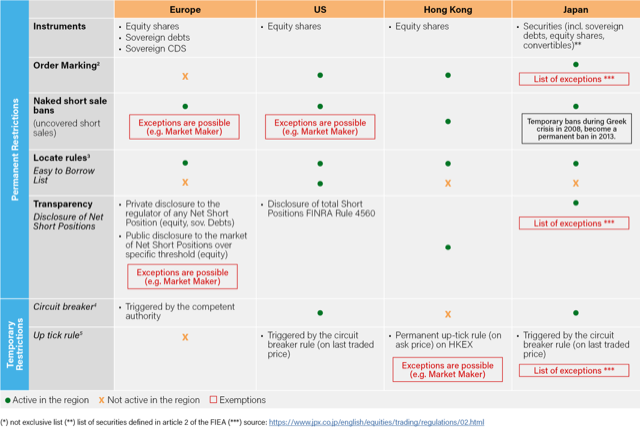
Naked short selling is banned by most exchanges – with certain exceptions that apply to market makers. Nonetheless, regulations for short selling vary around the world. Figure 3 provides an overview of short-selling regulations globally and compares their key characteristics.
Figure 3: Global Landscape of Short-selling Regulations for Equities Trading and Securities Financing
Source: SFC, FSA, SEC, FCA and GreySpark analysis
(Click on image to enlarge)
Definitions
Order Marking identifies trades as short sales for transparency and regulatory compliance purposes. This helps to ensure that the market accurately reflects the nature of the trades being executed.
Locate Rules require a broker-dealer to have reasonable grounds to believe that the security can be borrowed so that it can be delivered on the delivery date before effecting a short sale order.
Circuit Breaker Rule is designed to allow a temporary halt or restriction of short sales of an asset when the price drops sharply. The aim is to prevent excessive market volatility.
Uptick Rule requires short sales to be executed only at a price higher than the last different price or at an increment above the last trade. The aim is to prevent excessive downward pressure on the stock price.
Multinational financial intermediaries face significant challenges due to the regulatory complexity of short-selling rules across different jurisdictions, as depicted in Figure 3. Ensuring compliance with these diverse regulations requires a deep understanding of the individual jurisdiction’s specific requirements, such as disclosure rules, uptick rules and restrictions on stock eligibility for short selling.
A comprehensive framework for regulatory compliance includes the implementation of robust trading platforms that adhere to specific rules, such as the up-tick rule. The framework should be combined with a governance structure that ensures the continual monitoring and updating of exchange rulebooks. Specialised staff are essential for monitoring and adhering to various regulations. These staff members should be responsible for ensuring that internal procedures are continually reviewed, updated in the rulebooks and effectively integrated into the system.
GreySpark’s three-pronged approach can be implemented as part of the framework. This approach combines effective procedural controls with appropriate technological solutions to enhance compliance and prevent illegal short sales.
Three-pronged Approach to Prevent Naked Short Selling
GreySpark has designed a model which will allow firms to prevent and identify instances of naked short selling (see Figure 4). The three-pronged approach encompasses robust governance, system level Order Management System (OMS) configuration and an adherence to regulatory-compliant data standards, with the objective of strengthening controls against naked short-selling.
Figure 4: GreySpark’s Three-pronged Model to Prevent Naked Short Selling
Source: GreySpark analysis

Step 1: Perform Traceability and Gap Analysis on Regional Regulations and Exchange Rule Books
The Traceability and Gap Analysis focuses on an independent assessment and review of the firm’s current e-trading conduct related to short-selling activities in the various markets to measure its compliance against the rules set out by each market and the regional regulatory body. This analysis allows the firm to gain insight into the completeness of its procedures and controls. High, medium and low risk hot spots are identified and an estimate of the scope and effort of remediation is then devised to drive remediation priorities.
Figure 5: Two Key Activities and the Related Deliverables of Step 1 of GreySpark’s Three-pronged Approach
Source: GreySpark analysis

Figure 6 (a to d) illustrates this methodology for transitioning from gap assessment to the establishment of a compliance and documentation framework for the exchange rulebook policy. While a comprehensive traceability and gap analysis are of paramount importance to firms, conducting an effective traceability and gap analysis presents significant challenges:
- Resource Intensive: Conducting a thorough gap analysis requires a substantial number of people, time and expertise. Internal teams may lack the specific knowledge or experience needed to perform an in-depth analysis effectively.
- Complexity and Volume of Regulations: The sheer volume and intricacy of regulations make it difficult to ensure a thorough and accurate analysis. This process involves handling and comparing large amounts of data from different sources, and adhering to complex short-selling regulations, such as disclosure, reporting, up-tick price rules and restrictions on stock eligibility for short-selling.
- Frequent Updates and Interpretation Variability: Regulations and exchange rules are frequently updated, necessitating continuous monitoring and updating of knowledge. Establishing clear internal standards and procedures driven by systematic controls is crucial. However, different team members might interpret regulations and rules differently, leading to inconsistencies in the analysis.
- Balancing Operational Adequacy and Efficiency: There is often a paradox in balancing operational adequacy and efficiency with regulatory requirements. Firms must maintain records in accordance with regulatory guidelines and obligations while ensuring their operations remain efficient and effective.
The initial analysis phase, shown in Figure 6a, identifies relevant rules in the Regional Regulations and Exchange Rule Books, measures gaps against first line (1LOD) system controls across in-scope markets. Applicable rules are segmented into traceable audit rule objectives, for example:
- Trading (pre-trade checks, order book, etc)
- Market making
- Admission / membership
- Conduct
- Obligations (transparency, reporting)
- Technical requirements
The high-level heat map represents the current effectiveness of the FIs internal policies and procedures for discharging exchange rule book requirements.
Figure 6a: Regional Regulations and Exchange Rule Book Audit Process
Source: GreySpark analysis

The deployment of an efficient approach for addressing identified gaps discovered in the previous phase is achieved via the compliance and documentation framework (see Figure 6b). This framework is utilised to structure and organise firm’s existing documentation for discharging exchange rule book policy. The approach facilitates a targeted remediation planning process across the organisation, through each line of defence and to specific stakeholders.
Figure 6b: Proposed Compliance and Documentation Framework
Source: GreySpark analysis

(Click on image to enlarge)
Figure 6c shows how gaps can be addressed by:
- Utilising standard templates and policy/procedure mapping tools from in-house experience and best practices.
- Referring to the Regional Regulations and Structured Exchange Rule Book and 1st Line playbooks and system/control documentation framework.
- Managing a common procedure library referencing existing procedures, including completeness and effectiveness measures.
The deliverable should include a traceable exchange rule procedure inventory containing data points for gaps and directly mapped to the prioritised remediation plan.
Figure 6c: Compliance Documentation Framework
Source: GreySpark analysis

(Click on image to enlarge)
Repeating the gap analysis, as shown in Figure 6d, provides an updated view of the overall documentation and control gaps, illustrating improvements following the completion of remediation actions in a useful visual map.
Figure 6d: Rerun Regional Regulations and Exchange Rule Book Gap Analysis
Source: GreySpark analysis

Step 2: Configuring the Regulatory Rulebook in Order Management Systems
The successful integration of rulebooks in Order Management Systems (OMS) helps to prevent illegal short selling by enforcing compliance with regulatory requirements and internal policies. OMS rulebooks include checks and controls that ensure trades adhere to short-selling regulations, such as verifying the availability of securities for short-selling, monitoring compliance
with borrowing requirements and implementing pre-trade controls to prevent violations. These rulebooks integrate real-time monitoring and alerts to notify operations teams and compliance teams of potential breaches, enabling prompt intervention and enforcement of corrective actions. Additionally, comprehensive reporting functionalities within the OMS can add to audit trails and regulatory reporting, demonstrating adherence to short-selling rules and deterring illegal activities.
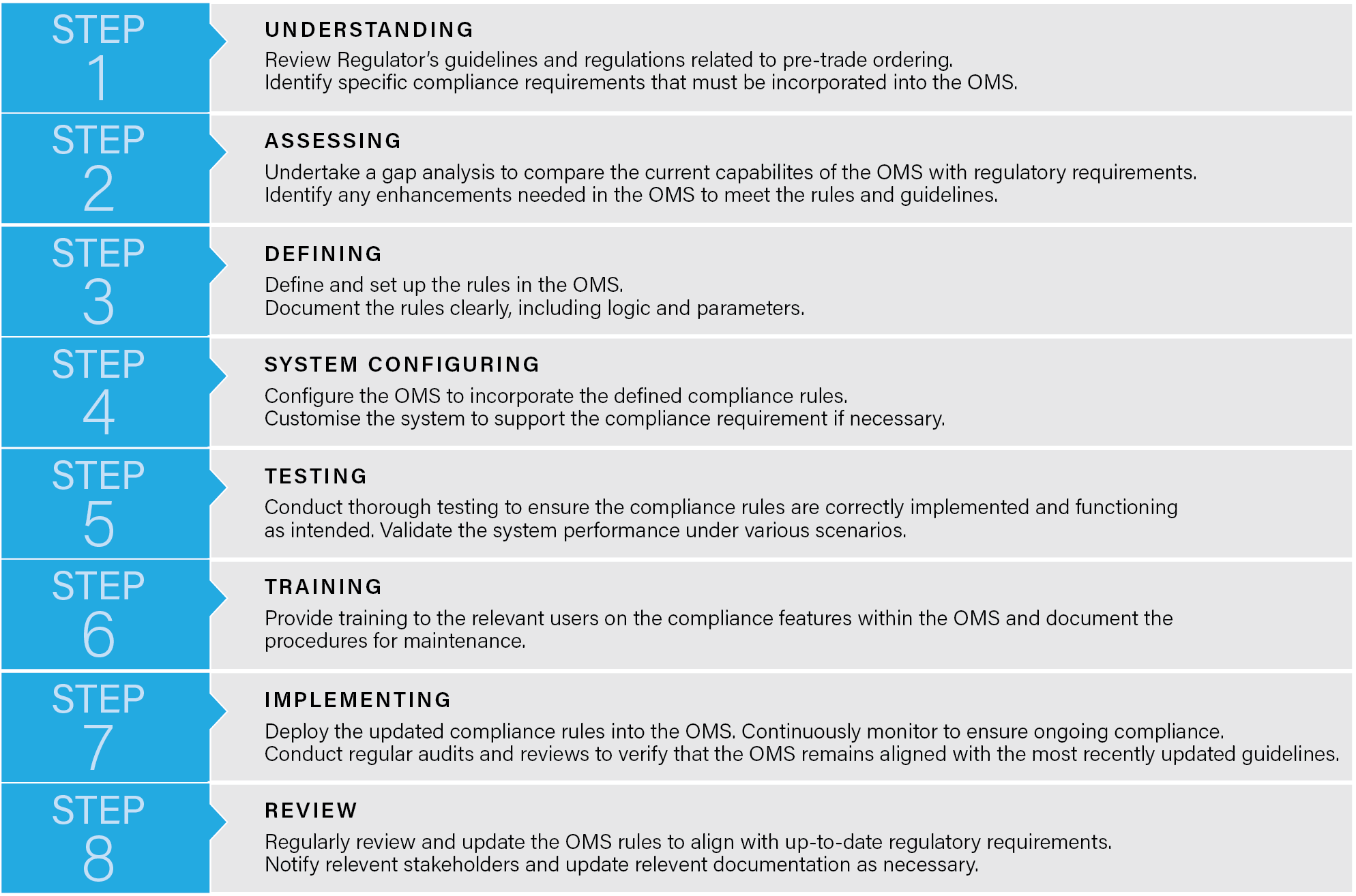
Meticulous planning is essential for analysing, defining, configuring, testing and implementing these rulebooks in the OMS. Figure 7 outlines the steps necessary for this implementation.
Figure 7: Process for Compliance Rule Setting in Order Management System
Source: GreySpark analysis
(Click on image to enlarge)
Step 3: Integrating Regulatory-compliant Data Standards into a Technology Solution
To facilitate the inspection process by the regulator looking for illegal short-sales trading, an industry-wide convention should be developed and enforced for financial institutions to adopt. For example, in Hong Kong, the electronic data standards of DS-OL were established to readily reconstruct order life cycles from initial receipt of an order instruction to final execution or cancellation. Control deficiencies and instances of non-compliance with the regulator’s Code of Conduct can be detected using data standards such as DS-OL. The implementation of a technological solution that incorporates the DS-OL standards can only be achieved when:
- Firms agree to and follow a convention that is able to handle the heterogenous data formats of all financial institutions.
- There is the capability to ingest and analyse large datasets.
- Analysis can be done on data as it is ingested, rather than waiting for the complete dataset to be ingested.
With modern streaming frameworks, such as Apache Spark Streaming or Apache Kafka, massive volumes of data can be handled by distributing the processing across multiple nodes in a cluster. This approach provides sufficient scalability to allow for the analysis of massive datasets. Analysis can be done before the entire dataset has been ingested, which enables real-time insights and decision-making. The capability to generate instant red flags is crucial for applications that detect illegal short-sell trades.
Figure 8 illustrates a simplified end-to-end workflow for implementing DS-OL, highlighting the essential components, intermediate processes and the generated output. By carefully planning test cases to identify potential fraud patterns and red-flag data, DS-OL establishes a standard protocol that significantly reduces the inspection workload for regulatory bodies. This protocol minimises the need for customisation or fine-tuning, thereby facilitating the efficient inspection and identification of potential fraud cases.
Figure 8: Workflow to Perform Data Analytics on Large Trading Dataset using DS-OL as an Example
Source: GreySpark analysis

Deep Data Analytics Expertise is Critical to Success
The trend towards integrating RegTech to automate the regulatory compliance controls, which were traditionally performed manually is becoming standard practice. Regulators are increasingly requiring financial institutions to adhere to stringent controls to detect non-compliant trading behaviours. Rule-based algorithms like DS-OL are pivotal to identify issues and raise red flags to indicate potential misconduct in equities trading, such as short selling.
Regulatory bodies are tasked with preventing incidents like the recent one in South Korea. However, financial institutions face challenges due to limited implementation experience and understanding of the necessary procedural controls. Compounding this issue is the diverse OMS solutions used across institutions and the industry which, while robust in operational functionalities, often do not meet specific data requirements of local exchange rulebooks.
Financial institutions must undertake the following measures to ensure robust internal control processes to prevent illegal short-selling activities:
- Evaluate the effectiveness of current compliance controls for short selling throughout the entire trade life cycle, designing and adopting rulebooks in line with local regulations and exchange rules.
- Gain a deep understanding of OMS vendor capabilities, including configuring and implementing system rules to generate real-time alerts for flagged short-selling trades.
- Understand the nuances and implementation intricacies of rule-based algorithms like DS-OL, particularly concerning regulatory standards for handling large volumes of trading data.
GreySpark Partners recommends firms follow our comprehensive three-pronged approach model, supported by subject matter experts, who can help implement advanced data analytics technology to prevent illegal short-selling.
GreySpark Partners is a business and technology consultancy specialising in mission-critical areas of the capital markets industry, helping our clients to address challenges and adapt to a changing technology environment wherever they operate.
GreySpark consultants are experienced practitioners, with familiarity of local regulatory landscapes and practical experience in providing advisory services, as well as assisting our clients with the heavy-lifting of implementation of front-to-back office systems. For more information, please contact GreySpark Partners to see how we can help with your system design and implementation of trading risk management and regulatory compliance procedures and controls.